

-1.png)
While drafting this, two new leveraged products landed on the listings desk this morning: a 3x note and a 2x daily ETF, both tracking the DRAM memory chip supercycle. Not a single stock this time. A single sub-sector of the semiconductor trade, wrapped in daily leverage, live on exchange as of today.
That is not an isolated curiosity. It is the leveraged ETF market's operating model in 2026.
From tactical instrument to retail default
Leveraged and inverse funds have existed since 2006, but the last five years changed what they are for. Since 2020, leveraged fund volumes have grown at a 29% annual pace, outpacing growth in both standard options and cash equity trading. By late November 2025, total assets across leveraged products reached roughly $160.5 billion, spread across 452 funds covering equities, commodities, crypto, and FX. Trading volume for 2025 was on pace to more than double year over year.
The driver is retail. Active retail traders account for only about 5.5% of overall US equity trading, yet they generate roughly 90% of leveraged fund turnover. Pandemic-era lockdowns created a generation of self-directed investors, and leveraged ETFs gave them amplified exposure without a margin account or a derivatives approval process. The single-stock leveraged ETF, introduced in 2022 on names like Tesla and Nvidia, accelerated that shift again: single-stock products now represent roughly half of all leveraged equity fund volume. This week's DRAM launches suggest the next iteration is single-theme leverage on hot sub-sectors, not just single names.
The chart that shows it happening in real time
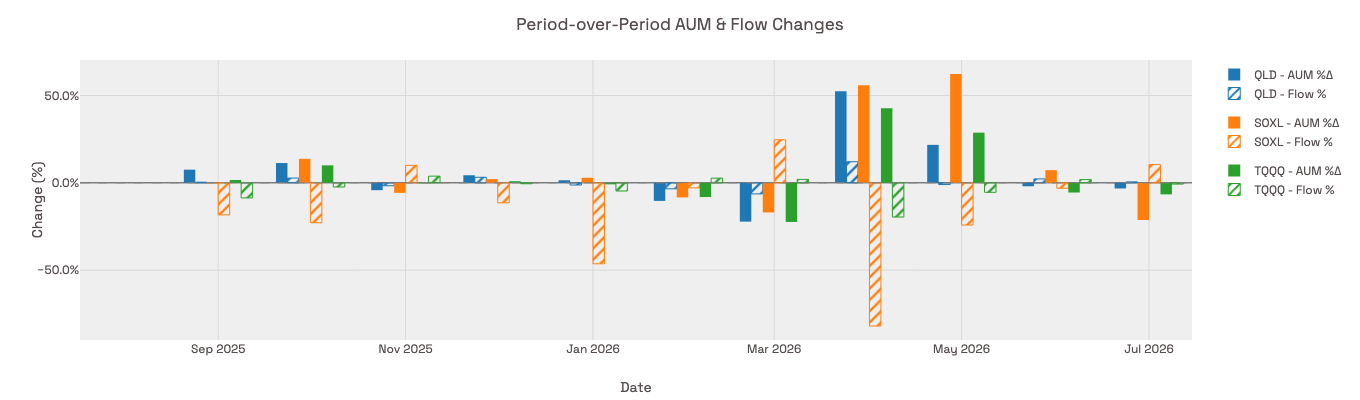
Pull the AUM history on three of the most heavily traded leveraged products, ProShares UltraPro QQQ (TQQQ, 3x Nasdaq-100), Direxion Daily Semiconductor Bull 3x (SOXL), and ProShares Ultra QQQ (QLD, 2x Nasdaq-100), and the "buy the dip" pattern described after the 2025 Liberation Day tariff shock is still playing out.
Combined AUM across the three funds fell from $54.8 billion in January 2026 to $39.5 billion by March 2026, a drawdown of roughly 28% in two months as the Nasdaq sold off. Retail did not step back. It stepped in. Combined AUM more than doubled from that March trough to $79.4 billion by June, an increase of over 100% in three months. SOXL alone went from $10.3 billion to $28.0 billion, up 171%. TQQQ climbed to a period high of $39.5 billion in May, up 84% off its low. That rebound has since given back some ground: SOXL and TQQQ are down 21% and 12% respectively from their peaks into July, while QLD has held up better, off just 5%. The round trip itself is the story: sharp collective drawdown, sharper collective inflow, and a fresh cohort of positions now sitting through the pullback.
This is the mechanism the sceptics describe as a volatility amplifier and the mechanism the data says is closer to a sentiment gauge. Both can be true at once.
The mechanics behind the multiple
Most leveraged ETFs reach their target exposure, typically 2x or 3x, through swaps and futures rather than direct stock ownership. In a total return swap structure, a bank effectively invests a multiple of the fund's capital and pays the fund the corresponding multiple of the daily return, collecting interest on the loan in exchange.
The critical word is daily. Leveraged ETFs reset their exposure every trading day, which means the stated multiple applies to that single day's return only. Returns do not compound cleanly over longer holding periods, and choppy, sideways markets can produce losses even when the underlying index ends up roughly flat. That structural cost, plus the expense of running swap books, is why a 3x S&P 500 fund like Direxion's SPXL carries an expense ratio of 0.87 to 0.95%, against 0.03 to 0.08% for a plain S&P 500 tracker like Vanguard's VOO.
Does the daily rebalancing actually move markets?
The standing criticism of leveraged funds is that their daily rebalancing, selling into falling markets and buying into rising ones, amplifies the moves it is reacting to. The evidence from the most stressed period in the sector's history does not support that.
During the 2020 Q1 turmoil, the average daily rebalancing demand ratio for the four largest 3x S&P 500 leveraged funds was 1.89%, peaking at 5% on March 16, 2020. Even at that peak, the impact on underlying security turnover was assessed as low. Hong Kong's regulator found similar results monitoring HSI and HSCEI leveraged products, with rebalancing demand staying well below the 25% warning threshold of index futures turnover. The rise in E-mini S&P 500 futures volume during the period was enough to absorb the rebalancing flow without generating disorderly selling pressure. Most closures during that quarter came from equity and oil-linked leveraged and inverse products reaching structural limits, not from broad market dislocation caused by the funds themselves.
Three shocks, three different investors
The retail playbook has visibly changed across cycles. In the 2020 COVID crash, traders flipped rapidly between bullish and bearish positioning and turnover quadrupled. In the slower 2022 inflation downturn, early dip buying gave way to exhaustion and a rotation into short positions. In the 2025 Liberation Day selloff, a 19% tariff-driven drop, investors bought long funds for 35 consecutive days. The current chart data suggests that conviction has carried into 2026: the March drawdown in TQQQ, SOXL, and QLD produced buying, not capitulation, at a scale that took combined AUM to a new high within three months.
The part that gets lost in the enthusiasm
None of this changes the underlying risk profile. The daily reset means a few volatile or sideways sessions can erase gains and compound losses even when the index eventually recovers to its starting point. SPXL returned 1,380% over the trailing decade against 274% for the S&P 500 itself, but capturing that required sitting through downturns three times as steep as the index, a risk tolerance most investors do not actually have. These products are built for short-term tactical trades, not long-term compounding, and the growing volume of new single-name and single-theme launches (DRAM leverage, launched today, is simply the latest example) is expanding the number of ways to take that trade, not reducing the risk of taking it.
What leveraged ETF positioning increasingly offers the rest of the market is a live, tradeable proxy for retail sentiment, arguably more granular and more immediate than options flow. For anyone building or maintaining index and ETF infrastructure, that positioning data, and the flow behind it, is becoming as important to track as the products themselves.
.png?width=1360&name=newplot%20(3).png "newplot (3)")
.png?width=1360&name=newplot%20(2).png "newplot (2)")
.png?width=1360&name=newplot%20(1).png "newplot (1)")
Comments