

-1.png)
Giant equity ETFs garnered most of the inflows in October – but the regional breakdown does vary amongst the US, Europe and Asia. Digital asset ETFs are now seeing inflows comparable to commodity ETFs and it is worth looking at multiple positive regulatory drivers.
Market Dynamics and Competition
Bigger and Cheaper ETFs Grow Market Share
ETF investors understand how fees impact the long-term returns of their investments. The cheapest passive index tracker products are growing market share – this applies to the oldest ETF markets tracking US equities such as VOO charging 0.03% and the newest ones tracking Bitcoin such as IBIT charging 0.25%.
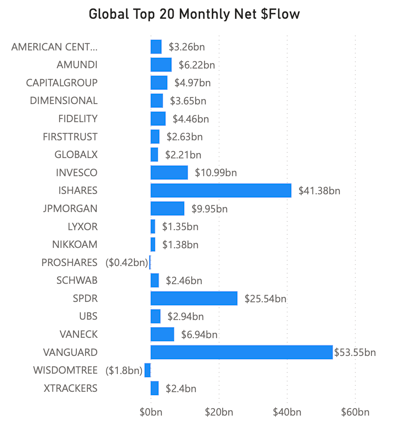
Vanguard goes from strength to strength as its inflows of $53.55 billion were well above – and its average OCF costs well below – iShares and SPDR. The standout performer was Vanguard's VOO, which gathered an exceptional $19.76 billion in October alone. This single fund accounted for over a third of Vanguard's total monthly inflows and demonstrates the continued flight to low-cost, broad market US equity exposure.
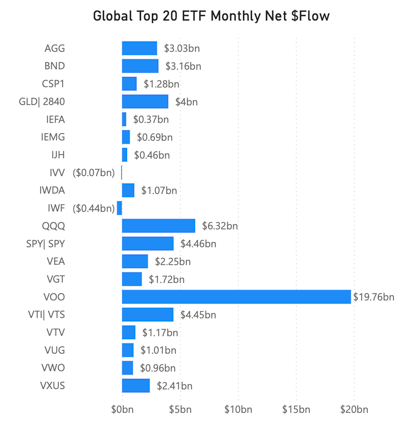
Vanguard's US ETF VTI is cross-listed in Australia as VTS, gathering even more demand.
Mid-tier players cannot compete on plain vanilla ETFs and need to differentiate their offering with the sorts of unusual small cap and thematic launches that Ultumus highlights in its monthly launch highlights round up.
Asset Class Focus – Digital
iShares’ IBIT Benefits from US Regulatory Drivers
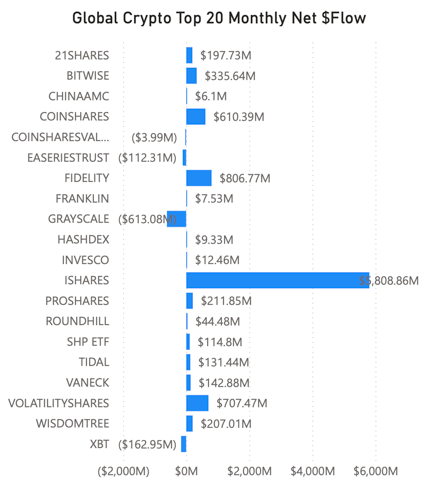
Europe was a first mover on digital asset ETFs but the US has now overtaken Europe as regulation is more supportive – and iShares now runs over $100 billion in digital asset ETFs globally.
BlackRock's iShares ETF IBIT got a first mover advantage as one of the first spot Bitcoin ETFs approved by US regulators on January 10, 2024. In 2024 it was once again the first Bitcoin ETF approved for options trading on September 20, 2024. This increases demand because banks and brokers making markets in IBIT options lay off their exposure through trading the ETF.
In July 2025 the SEC allowed in kind creation and redemption of crypto ETFs, matching the regime for other ETFs – and improving liquidity.
Meanwhile, Asia is lagging behind in digital assets with only a small handful of products approved and none of the leading US players managing products.
US and Asia stay Local – while Europeans go Global
Europeans seek geographic diversification
In the US and Asia over half of the largest ETFs and largest inflows are local market equity ETFs and over three quarters are local including fixed income.
In Europe, the largest ETFs and inflows are dominated by US and global equity ETFs. Only 2 of the largest 20 European ETFs invest in European and UK equities. The two largest European equity ETFs by AUM – CSP1 and IWDA – both provide global and developed market exposure excluding or minimizing European holdings.
This is partly based on historical performance – though European equities are outperforming in 2025, they have massively lagged US and global equities on a 5-, 10- or 15-year lookback view. Europe's economies are big exporters, so investors naturally look toward markets where their biggest customers are located.
Asset Class Focus – Gold
Transatlantic Divergence in Gold Flows
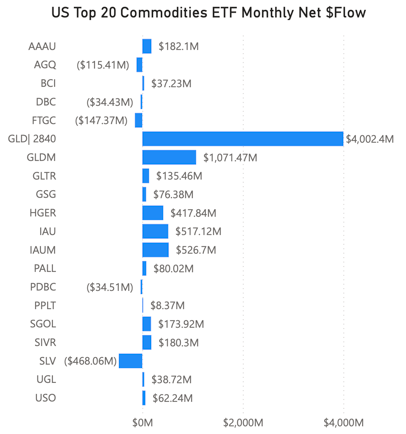
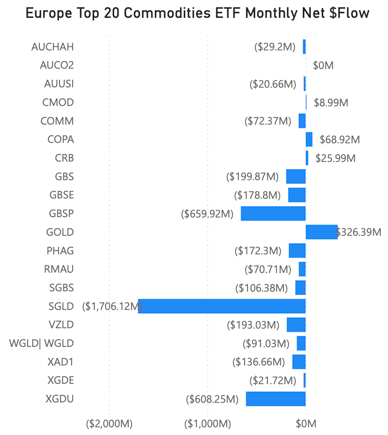
Gold is the only commodity ETF in the top 20 in both Europe and the US, but October saw flows move in opposite directions. Amid the largest pullback in gold since 2013, Europeans sold gold ETFs while US investors "bought the dip" and added to them. US gold ETF GLD gathered $4.00 billion in inflows, while Europe's largest gold ETF SGLD saw $1.71 billion in outflows.
Infrastructure and Operational Implications
Operations need to be scalable to match giant ETFs with cross border listings. Operations need to be automated and efficient to meet growing volumes of trading and manage liquidity throughout the trading day and across multiple venues around the globe.
Operational infrastructure needs to keep up to speed with the special features of spot digital assets in terms of custody, trading on different exchanges, and trading 24/7 for out of hours quotes.
Outlook – Trends to Watch
If more European regulators follow the UK in approving digital asset ETFs for retail investors, European digital ETF assets might start to catch up with the US.
If Vanguard launches more local ETFs - and cross-lists more ETFs in more overseas markets - it could become even more dominant in passive ETFs.
Europe's top 20 include more "complex" and controversial products: a 3x leveraged S&P 500 ETF from Direxion, and a covered call strategy from Roundhill. We have not yet seen leveraged or covered call products in the top 20 US though there are lots of new launches.
Though active ETFs in aggregate are gathering a growing share of inflows, the individual products are not yet big enough to appear in our top 20 rankings. As large mutual fund conversions into ETFs continue, it is probably only a matter of time before we see some active ETFs at the top of the league tables.
Comments